Auroras expected to dazzle again tonight – Technology & Science – CBC News.
This story is actually from last night – but check out the pictures.

Auroras expected to dazzle again tonight – Technology & Science – CBC News.
This story is actually from last night – but check out the pictures.

The Moon and Pluto compared to the Earth. This picture was composed from File:Enceladus Earth Moon Comparison.png, File:Full Moon Luc Viatour.jpg, and File:Pluto impression.png, by Tom Reding (Wikimedia)
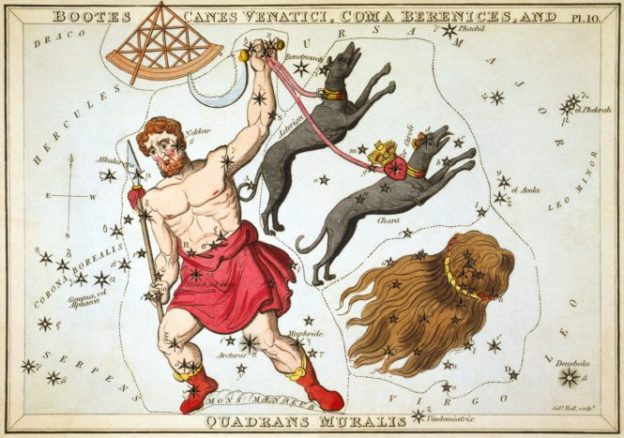
Arcturus is an orange giant, and the fourth brightest star in the sky. Its moment of earthly fame came during the Chicago World Fair of 1934. There had been a World Fair in Chicago in 1893, and they calculated that light leaving Arcturus then would arrive in time for the new Fair.*
The easiest way to spot the constellation Leo in the sky is to look for the Sickle, shaped like a backwards question mark. Regulus is the dot of the question mark. It is a bluish star, and it can be seen all around the globe. It is the 22nd brightest star, although the 21st, Alpha Centauri, is not much brighter than it is. Regulus is not a binary star for once, although there is a binary nearby, and possibly a white dwarf.

Stars wheel in purple, yours is not so rare
as Hesperus, nor yet so great a star
as bright Aldebaran or Sirius,
nor yet the stained and brilliant one of War;
stars turn in purple, glorious to the sight;
yours is not gracious as the Pleiads are
nor as Orion’s sapphires, luminous;
yet disenchanted, cold, imperious face,
when all the others blighted, reel and fall,
your star, steel-set, keeps lone and frigid tryst
to freighted ships, baffled in wind and blast.
H.D. (Hilda Doolittle)
If you like the image at the top, click here.

Orion is a large, striking constellation, with many bright stars. I have already written about Rigel, its brightest star. Of its other bright stars, Betelgeuse is 12th brightest in the sky, while Bellatrix is down there at 27th.
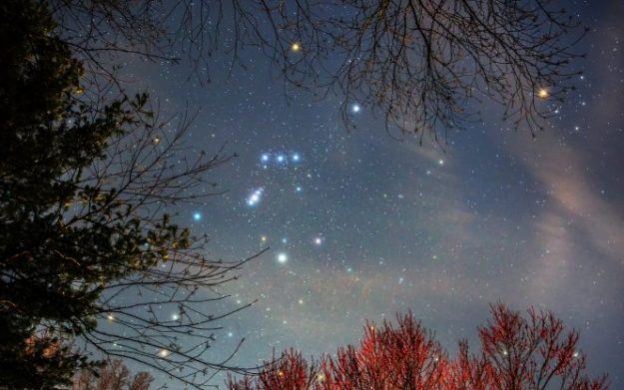
`You know Orion always comes up sideways.
Throwing a leg up over our fence of mountains,
And rising on his hands, he looks in on me
Busy outdoors by lantern-light with something
I should have done by daylight, and indeed,
After the ground is frozen, I should have done
Before it froze, and a gust flings a handful
Of waste leaves at my smoky lantern chimney
To make fun of my way of doing things,
Or else fun of Orion’s having caught me.
Has a man, I should like to ask, no rights
These forces are obliged to pay respect to?’
So Brad McLaughlin mingled reckless talk
Of heavenly stars with hugger-mugger farming,
Till having failed at hugger-mugger farming
He burned his house down for the fire insurance
And spent the proceeds on a telescope
To satisfy a lifelong curiosity
About our place among the infinities.

Sirius is the brightest star in the night sky – its modern name comes from the Ancient Greek Seirios (“glowing” or “scorcher”). It is actually another one of those binary stars, a white star and a white dwarf. Like Procyon, its nearness to Earth makes it much brighter in the night sky than many other stars. It is brighter than our sun, but dimmer than Rigel and Canopus.

Procyon suffers from an inferiority complex – even its name points to a more important star. Procyon means “before the dog”, meaning Sirius, the dog-star. (Fun fact: the racoon genus is called Procyon, because it used to be thought that raccoons evolved before dogs.)
 We Are Star Stuff