The Mummers’ Festival Page
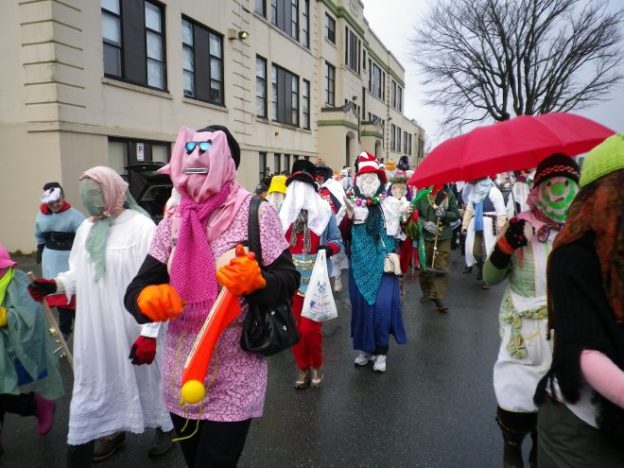
CBC Coverage of this year’s parade
And a travel blogger’s reaction to the parade
The image at the top comes from the CBC blog. Click here to see more.
The Mummers’ Festival Page
CBC Coverage of this year’s parade
And a travel blogger’s reaction to the parade
The image at the top comes from the CBC blog. Click here to see more.
Two Norse deities can be connected to the álfar, or elves, of Norse myth. One is Freyr, who had Alfheim as a tooth-gift, and was ruler of the álfar. The other is the sun-goddess, whose connection with the álfar runs much deeper than her by-name Álfroðull, or Elfin Beam.
Celebrity feuds are the meat and drink of modern gossip columns. But what do you do when it’s two gods duking it out? The Greeks had plenty of god feuds, as you might expect, including Poseidon vs. Zeus, and Hera vs. Hercules. And the Norse had a god feud of their own, involving their two most important gods: Odin and Thor.
Gaulish Alesia, the home of Ucuetis and Bergusia, was nearly lost to history entirely. After Julius Caesar’s military successes in Gaul, the Celtic tribes formed an alliance to push the Romans back, led by the Arverni chieftain Vercingetorix. At first the Gauls scored several victories against the Romans, but at Alesia the Roman army settled down to a seige which only ended when Vercingetorix surrendered.
After that Alesia became a Roman oppidum, and seems to have prospered, becoming famous for its metalworking. In the 5th century, after the Western Empire collapsed, the Gauls abandoned the town. Alesia’s location became a mystery, solved only in 1838 when an inscription, IN ALISIIA, was uncovered. Napoleon III ordered archaeologists to excavate around Mt. Auxois, confirming that Alise-sur-Reine, near Dijon, was Alesia.
 We Are Star Stuff