
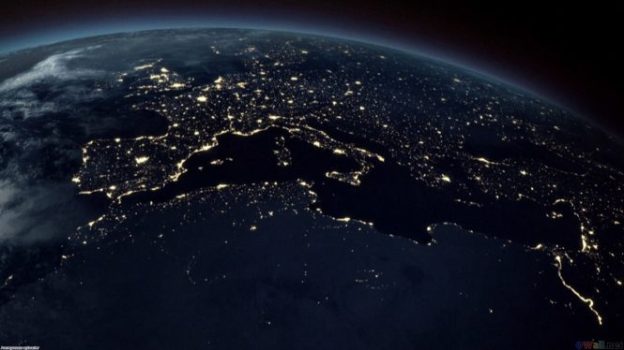
On a starred night Prince Lucifer uprose.

On a starred night Prince Lucifer uprose.
Tired of his dark dominion swung the fiend
Above the rolling ball in cloud part screened,
Where sinners hugged their spectre of repose.
Poor prey to his hot fit of pride were those.
And now upon his western wing he leaned,
Now his huge bulk o’er Afric’s sands careened,
Now the black planet shadowed Arctic snows.
Soaring through wider zones that pricked his scars
With memory of the old revolt from Awe,
He reached a middle height, and at the stars,
Which are the brain of heaven, he looked, and sank.
Around the ancient track marched, rank on rank,
The army of unalterable law.
(George Meredith, Lucifer in Starlight)

If you like the image at the top, click here.

Save

Spite and the Morning Star

The Iroquois Confederacy had a number of stories about the morning star, which they called Gendenwitha, It Brings the Day.

One story is about the beautiful woman named Gendenwitha. It began with a hunter who was captured by the dawn after he chased the Sky Elk into the heavens. She set him to guard her lodge and help the sky hunters.

He saw Gendenwitha, then a mortal, and fell in love. While the dawn was bringing in the day, he was singing to his love, as a bluebird in spring, then as a blackbird in summer, and as a hawk in fall.

Finally he went to earth in the form of a hawk, and took her up to the sky. The dawn was angry, and turned Gendenwitha into a star, which she placed above her door, out of reach of the hunter. And so Gendenwitha became the morning star.

If you like the image at the top, click here.

Save

Sokkvabekkr and Saga: Beneath the Waves

In my post on the enigmatic Norse god Hœnir, I mentioned two goddesses, Frigga and Saga. I argued that Hœnir personified poetic memory and inspired speech. His partner, Mimir, was the god of memory, without whom he couldn’t speak at all. Like our gods, Frigga and Saga have access to the knowledge of fate and of history. And like our two gods, one of them tells about it, the other doesn’t.

Continue reading

immortality

Earth the most great and Heaven on high!
Father is he to man and god
And she, who taketh to her sod,
The cloud-flung rivers of the Sky.

And beareth offspring, men and grass,
and beasts in all their kinds, indeed,
Mother of All. And every seed
Earth-gendered back to Earth shall pass,
And back to Heaven the seeds of sky:
Seeing all things into all may range
And sundering, show new shapes of change,
But never that which is shall die.

(Euripides, fragment, trans. Gilbert Murray)

PS – I thought this was a totally obscure quote, which Timothy Findley uses as an epigraph in The Wars. But someone else likes it enough to name their blog for it.

If you like the image at the top, click here.
Save

It’s Just A Fiery Ball of Metal! The Impiety of Being Right Too Soon

Sometimes it’s not good to be first. The ancient Greek philosopher Anaxagoras certainly found that to be true, after he was charged with impiety for teaching that the heavenly bodies were rocky balls whirling in the ether, fiery (and visible) because of their rapid rotation. He also held that the sun was a fiery metal ball, and the moon shone by reflection.

Continue reading

Hoenir, Memory, and Inspired Speech

Although Hoenir was a companion to Odin and Loki, two well-publicized Norse gods, very little has survived about him, and he does not seem to have had cult places or worshippers.

Which is surprising in a way, because in Völuspá he is the one performing the old rites after the world is reborn, so you automatically think “priestly god”. Several scholars have decided that his role was in fact a priestly or vatic one, based on this.

Continue reading