Category Archives: Mythology

it could be argued… that any myth is a neutral structure that allows paradoxical meanings to be held in a charged tension. Indeed, we might argue that this is one of the defining characteristics of a myth, in cotnrast with other sorts of narriatves (such as novels): a myth is a narrative that is tramsparent to a variety of constructions of meaning.
(Wendy Doniger, The London Review of Books, 30: 7 (10 April 2008): 27-29)

Astraios: Father of the Stars

Astraios was one of the Greek Titans, the older gods who ruled before Zeus and the Olympians. His name means “Of the Stars”, and he was the father of the stars and winds. Astrology was one of his specialties, but he was also connected to the seasons and possibly navigation.

Continue reading

Bow-Gods: Ullr, Skadi, and the Sami

The bow and arrow were so useful that the Norse had two different deities associated with them: Ullr and Skadi. Ullr skiied, travelled across the ice, and shot game with his bow. The giantess Skadi also skiied and lived in the mountains, like the indigeneous Sami, whose lifestyle was so different from that of the sea-faring and farming Norse.

Hunting with a bow was a Sami trait, along with the use of magic. Norse sagas don’t come right out and condemn archery, but in Norse myth Tyr and Thor use close-combat weapons, although Odin uses the arrow’s near relative, the spear.

Continue reading

Celtic Hercules

When you consider what Hercules did for Gaul, it’s no wonder that they loved him. He founded the city of Alesia, and introduced the rule of law. “And for the entire period from the days of Heracles this city remained free and was never sacked until our own time…”1 (Diodorus Siculus 4.19.1)

Other myths said that Hercules was the father of Celtos, Galatos and Iberus, the ancestors of the Celts, Galatians and Iberians. This would make him the ancestor of the French, Spanish and Anatolian Celts, who would thus become many-times-grand-children of Jupiter.

To honour their fore-father, they offered statuettes of him at shrines (especially the god Borvo’s), and many Gaulish gods, including Ogmios and Smertrios, were paired with him as part of interpretatio celtica. (MacKillop: 248)

Continue reading

Books on Brigit: a Review

Books Reviewed: Pagan Portals: Brigit – Morgan Daimler, Brigid: History, Mystery, and Magick of the Celtic Goddess – Courtney Weber, Brigid: Goddess, Druidess and Saint –Brian Wright, Brigit: Sun of Womanhood – Patricia Monaghan and Michael McDermott, and The Rites of Brigid: Goddess & Saint – Seán Ó Duinn.

“A teacher of mine believes a whole spiritual tradition could be filled solely with Brigid devotees…” (Weber, Loc. 49) This is probably true, and you could certainly fill a bookshelf with volumes on Brigit, goddess and saint. For this post I wanted to review books that would be easily available, written for a popular audience, and likely to appeal to readers. I could easily have gone past five, but anyone who is that enthusiastic about Brigit will no doubt find more on their own.

Continue reading

White Ravens and Apollo

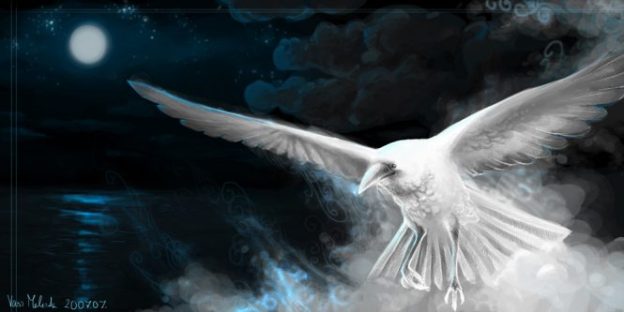
Two stories about Apollo, one well-known and one obscure, focus on white ravens. Odin sent out ravens to learn what was going on in the world, but Apollo’s white ravens also brought messages to humans, as servants of the god of oracles. The one occasion when a raven brought him news ended very badly indeed. Continue reading

Njord: God of Peace and Plenty

When you think of Norse myths, you tend to think of Thor, smiting the giants, or Odin, outwitting his opponents. Or perhaps you think of Loki, causing mischief wherever he goes.

But life is not all battles and uproar. Alongside the gods of war were the gods of peace and plenty, the chief of whom was the god Njord. Poets used his name as a kenning for “warrior”, so he must have been able to fight, but his real interest was good harvests, peace for his people, and wealth.

Njord’s nature reflects Norse society: we often think of him as a sea-god, but he really looked after sailors, merchants and all who travelled on the sea. Equally important, the god known as Njord the Wealthy would make your voyage worthwhile.

Continue reading

Midwives of Light: Eileithyia and Juno Lucina

Before Christmas I wrote about Holda, Berchta and Perchta, who led the wild hunt and perhaps received children in the afterlife. For the new year, I want to look at another trio of goddesses, who oversaw birth, and the infant’s journey into the light of life.

Continue reading

Perchta, Holda and the Wild Hunt

When we think of the Wild Hunt, we think of Odin, or his Germanic counterpart Woden. However, he was not the Hunt’s only leader. In this post I want to look at Perchta and Holda, and the specially feminine spin they gave their midwinter rout.

Continue reading

river water

Adsalluta and Savus

This post exists because of a mistake. When I was researching my post on Sulis, I came across references to a goddess Adsullata, who seemed similar. She was from Central Europe, and I was a bit excited at the thought that maybe Sulis wasn’t alone after all.

Unfortunately, it turned out that Adsullata was Adsalluta. She and her partner, Savus, are unusual in that they are a divine couple who retained their native names, with no Roman overlay. (The Epigraph Databank has eight entries for Adsalluta, seven for Savus, but none for Adsullata.)

Continue reading

Sulis: the eye, the sun, the well

Sulis is probably one of the more famous Celtic goddesses, even though she only has one cult site, at a thermal spring in south-west England.1 The site, known to the Romans as Aquae Sulis, was not only a spa, but had a temple to Sulis Minerva2, her Romano-Celtic form.

Continue reading