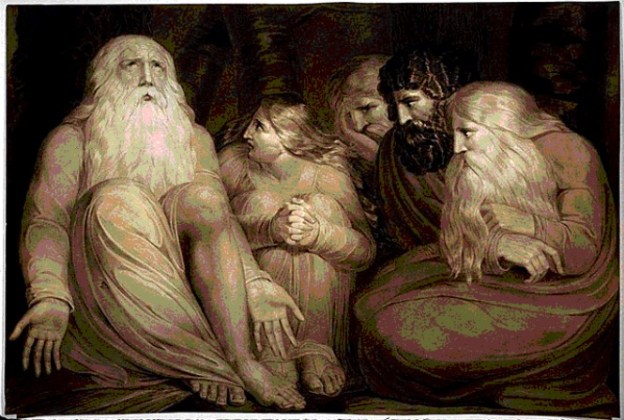
Job on the Stars

He is wise in heart and mighty in strength
    —who has hardened himself against him, and succeeded?—
he who removes mountains, and they know it not,
    when he overturns them in his anger,
who shakes the earth out of its place,
    and its pillars tremble;
who commands the sun, and it does not rise;
    who seals up the stars;
who alone stretched out the heavens
    and trampled the waves of the sea;
who made the Bear and Orion,
    the Pleiades and the chambers of the south;
10 who does great things beyond searching out,
    and marvelous things beyond number.
11 Behold, he passes by me, and I see him not;
    he moves on, but I do not perceive him.
12 Behold, he snatches away; who can turn him back?
    Who will say to him, ‘What are you doing?’

(Job 9: 4-12, from The Bible Gateway)

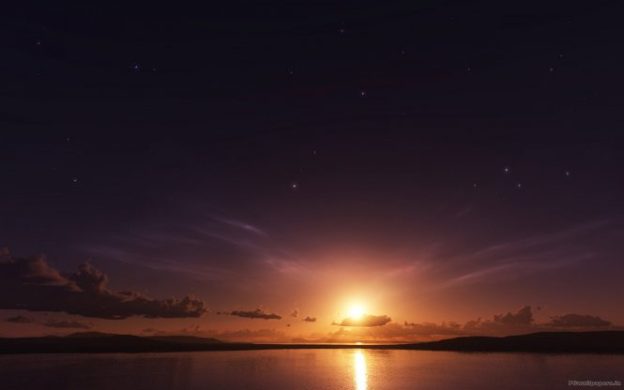
The image at the top comes from here.

Save

Crumble: Not so humble.

It’s funny that my favourite dessert achieved fame because of rationing. Crumble, or crisp for North Americans, became popular in Britain during WWII because it used less fat and sugar than pie crust, and you could use breadcrumbs to bulk it out. At a time when propaganda posters warned against wasting bread, every crumb counted.

Continue reading

Manannan mac Lir (and some Norse connections)

Manannán is in many ways like a more benign version of Oðin. Like the Norse god, he is the patron of many heroes, is skilled in both battle and magic, moves easily between the worlds and has many lovers as well as a wife. On a more fantastic level, both have horses that can travel over land and sea, and a boar or pigs that renew themselves after being eaten.

He seems to have been one of the old gods, rather than the Tuatha de Danann. Unlike them, however, he seems to have made his peace with the new order, as he appears in their adventures. (He was close enough to them to be foster-father to the young god Lugh.) When the Milesians (humans) came, and the TDD went into the hollow hills, Manannán divided up the otherworld into parts for each.

Continue reading

Green Chili: Okay or weird?

There’s a chili recipe I love making. I love it so much that in order to make it in northern Canada, I will mail order catering-size cans of tomatillos. Yes, I’m talking about chili verde, that lovely mix of tomatillos, green chilis, cilantro and pork that I can’t get enough of.

All the same, I’ve had people look at it, make a doubtful face, and say, “When I think of chili I think of beef… and it’s red.” The last time I made it one of my brothers was there, and he was game to try it, but a bit puzzled by the ingredients, until I fried the chili powder and cumin. “Well, it smells like chili, anyway,” he commented. (Side note: he cleaned up the finished product.)

Continue reading

Brigit and Lugh

The Irish goddess Brigit and the god Lugh have a great deal in common. Both have a triple form, both are powerful at every level of society, and both have a major calendar holiday associated with them. In the myths of the war between the two groups of gods, they have family on both sides.

Continue reading

Agent of S.T.Y.L.E. – DC’s Captain Marvel | The Mary Sue

Agent of S.T.Y.L.E. – DC’s Captain Marvel | The Mary Sue.

Faoladh: Werewolves of Ireland

The other day I was browsing Tumblr and I turned up a post on Irish werewolves. I knew Irish mythology and folklore had lots of shapeshifters, but I had never heard of werewolves. Better still, it turned out that not only does Ireland have werewolves, but also its own form of Úlfhéðnar, the berserker-like wolf-warriors of Scandinavian legend.

There are no real wolves in Ireland any more, but they were once a very real menace, which would explain the large number of stories about them.

Continue reading

The Dark Side of the Sun: Circe, Medea, Pasiphae, Hecate

This post covers the darker side of Helios‘ family. These include Circe, Pasiphaë, and his granddaughters Medea and Hecate. Unlike his brighter descendants, who were mostly the children of Klymene, these were the children of Perseis, an Oceanid nymph. (Her name comes from the word persô, meaning to destroy, slay, ravish, or sack with fire, so perhaps her dangerous offspring shouldn’t be a surprise.)

Continue reading

Dis Pater: Who was he?

Julius Caesar wrote that the Gauls believed they were descended from Dis Pater. In his writings, he did not give the local names for his deities, substituting ones his readers would recognize. (This was the interpretatio romana, giving foreign deities Roman names and attributes.)

Dis was originally the Roman god of wealth, fertile soil, and underground riches, who became equated to Pluto, Orcus, and Soranus. The question is, what Gaulish god reminded the Divine Julius of Dis?

Continue reading

blue sky light

Theia, Phoebe, Helia

The family of the sun-god Helios features many minor goddesses of sun and light. Helios is the main god of the sun; his name, and his resemblance to many Indo-European sun-gods and goddesses puts that out of doubt, but it is interesting how solar females cluster around him.

Some of these goddesses may well have had their own solar cults long ago, but it’s impossible to verify now.  Two of them were his mother and aunt, the other was his daughter. (Helios’s lineage also includes the witches Circe and Medea, as well as Hecate, a grand-daughter in some versions of her family tree.)

Continue reading