Category Archives: Celtic

Smith-gods: Goibniu, Gofannon and Cobannos

Humans have been working with metal for a long time: from the Copper Age (approx. 3500 – 1700 BCE) when the soft, malleable metal was the first to be smelted and used. So it’s not surprising that many cultures have smith-gods, and that in the Celtic world the smith-god and his name occur in Gaul, Wales, England and Ireland, making him one of the few pan-Celtic deities.1

And a very literal one – Goibniu, Gofannon and Cobannos all mean “Smith”.
Continue reading

Cernunnos: God of Wealth, the Wild, and Big Gold Torcs

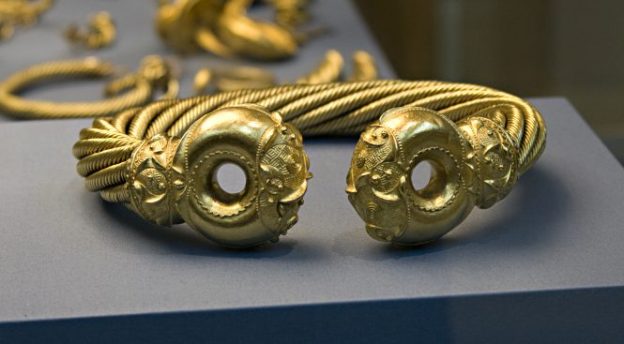
I was seriously tempted to call this piece “Cernunnos: God of Bling”. This may seem a wildly inappropriate way to describe a god revered by neo-Pagans and possibly the divine ancestor of the Gauls, but when so many images of him feature one or more torcs, which are simply enormous gold necklaces, how can you resist?

Continue reading

Celtic Minerva

Searching out Minervas always feels like seeing through a scrim; when you look at the Roman goddess, you see her through the Greek and Etruscan influences that went into her making. Looking at the Celtic goddesses who were compared to Minerva, named for her, or depicted in her image, you see through yet another veil, trying to discern the Celtic form under the Roman covering.

Continue reading

Celtic Victory

The Celtic peoples had many gods of war, if the number linked to Mars is anything to go by. They also had a lot of war-goddesses, whom we would expect to be associated with Minerva, Bellona or Victoria.

Surprisingly, goddesses paired with Victoria are pretty rare (I will look at Minerva in another post), although there are a few. There are also some native goddesses named “Victory”, all from modern France.

Continue reading

Hammer-Gods: Thor, Hercules and Sucellos

These three gods have a lot in common: they’re all brawny types whose worshippers were mainly working people, farmers, labourers, miners and even slaves. But what intrigued me about them was that their followers all wore their symbol – the hammer or club each god wielded.

Continue reading

Boand, Anahita and Saraswati

My first post on the Irish goddess Boand sparked a question on the Mythology Stack Exchange about cows as symbols of wisdom. There is a blog called The Wisdom of Cows, but I suspect that a mythological version wouldn’t run long.

However, Boand is the goddess of the river Boyne, and there are many examples of river-goddesses who give inspiration, wisdom and sometimes musical talent to their worshippers. Continue reading

Cernunnos and Flidais post for Dun Brython

Check out my piece on Cernunnos and Flidais on the Dun Brython blog.

Is Danu a real goddess?

One of the things everyone knows about Irish mythology is that the deities we all know (Brigit, the Dagda, Boand, Ogma, etc.) are all members of the Tuatha de Danann, the people or tribe of the goddess Danu.

However, none of the Irish sources mention this goddess, who was an important enough ancestor that her name identified all of her descendants. (Imagine if the Olympian gods of Greece were known as the Gaians, for example.) Some Celtic scholars have gone so far as to doubt the existence of any such deity. Why?

Continue reading

Boand: river-goddess and rebel

The Irish goddess Boand is famous for two things: she is the mother of the young god Aengus, whom she carried to term in a single (nine-month-long) day, and the river Boyne is named for her, after she caused it to gush forth from a magical well.

Continue reading

Celtic Hercules

When you consider what Hercules did for Gaul, it’s no wonder that they loved him. He founded the city of Alesia, and introduced the rule of law. “And for the entire period from the days of Heracles this city remained free and was never sacked until our own time…”1 (Diodorus Siculus 4.19.1)

Other myths said that Hercules was the father of Celtos, Galatos and Iberus, the ancestors of the Celts, Galatians and Iberians. This would make him the ancestor of the French, Spanish and Anatolian Celts, who would thus become many-times-grand-children of Jupiter.

To honour their fore-father, they offered statuettes of him at shrines (especially the god Borvo’s), and many Gaulish gods, including Ogmios and Smertrios, were paired with him as part of interpretatio celtica. (MacKillop: 248)

Continue reading