Category Archives: Celtic

Books on Brigit: a Review

Books Reviewed: Pagan Portals: Brigit – Morgan Daimler, Brigid: History, Mystery, and Magick of the Celtic Goddess – Courtney Weber, Brigid: Goddess, Druidess and Saint –Brian Wright, Brigit: Sun of Womanhood – Patricia Monaghan and Michael McDermott, and The Rites of Brigid: Goddess & Saint – Seán Ó Duinn.

“A teacher of mine believes a whole spiritual tradition could be filled solely with Brigid devotees…” (Weber, Loc. 49) This is probably true, and you could certainly fill a bookshelf with volumes on Brigit, goddess and saint. For this post I wanted to review books that would be easily available, written for a popular audience, and likely to appeal to readers. I could easily have gone past five, but anyone who is that enthusiastic about Brigit will no doubt find more on their own.
Continue reading

Perchta, Holda and the Wild Hunt

When we think of the Wild Hunt, we think of Odin, or his Germanic counterpart Woden. However, he was not the Hunt’s only leader. In this post I want to look at Perchta and Holda, and the specially feminine spin they gave their midwinter rout.

Continue reading

river water

Adsalluta and Savus

This post exists because of a mistake. When I was researching my post on Sulis, I came across references to a goddess Adsullata, who seemed similar. She was from Central Europe, and I was a bit excited at the thought that maybe Sulis wasn’t alone after all.

Unfortunately, it turned out that Adsullata was Adsalluta. She and her partner, Savus, are unusual in that they are a divine couple who retained their native names, with no Roman overlay. (The Epigraph Databank has eight entries for Adsalluta, seven for Savus, but none for Adsullata.)

Continue reading

Sulis: the eye, the sun, the well

Sulis is probably one of the more famous Celtic goddesses, even though she only has one cult site, at a thermal spring in south-west England.1 The site, known to the Romans as Aquae Sulis, was not only a spa, but had a temple to Sulis Minerva2, her Romano-Celtic form.

Continue reading

Medusa, Rhiannon, Macha: the horse-goddess and her twins

The imagery of the Greek Gorgon can be traced back to Persian and Near Eastern art, but the myth of the beautiful Medusa seems to come from a different source. A story found in various forms in Greece, India, Ireland and Wales tells of a woman who either becomes a horse or has a strong equine connection, gives birth to twins and suffers greatly.

However, Demeter, Saranyu, Macha and Rhiannon are goddesses, while Medusa is considered a monster. Still, her story is so similar to these others that it obviously descends from the same Indo-European myth.

Continue reading

The Former Gods

Human rulers die, and the next generation takes over. Sometimes the older generation gets “helped” off the throne, either by assassination or war. So it’s not surprising that mythology has many versions of this succession story, which rarely involve peaceful inheritance.

Continue reading

Odin and the Morrigan

This week’s post could easily have been called “fearsome deities“: Odin, whose name means “fury”, and the Morrigan, who steps out of the fairy realm to stir up war and slaughter. It’s not hard to see what they have in common.

Continue reading

Milk and Blood: Brigit and the Morrigan

Back in 1977 Patrick Ford published a paper called “Celtic Women: the Opposing Sex”. It could have been tailor-made for the Morrigan, a fearsome goddess who spends most of the Tain trying to destroy the hero Cúchulainn. By contrast, Brigid seems to be the “good girl” of Irish myth.

Continue reading

The Eye and the Well: Odin and Brigit

Odin and Brigit may not seem like the most similar deities, but they actually do have more in common than you might think. Both are patrons of poets, both give up an eye voluntarily, and both these losses are connected with water.

Continue reading

The Salmon of Wisdom

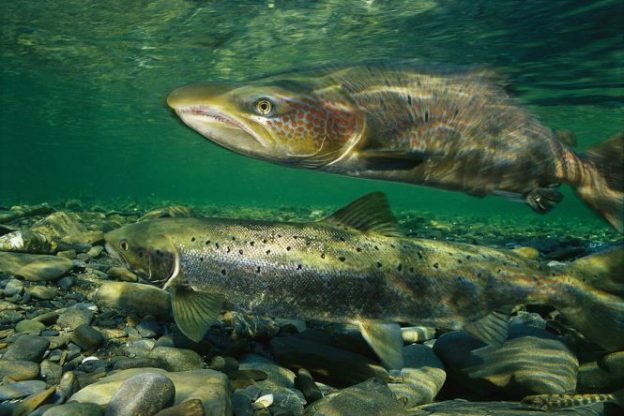
You might wonder, why are salmon wise? Their ability to return to their birthplace to spawn may have given rise to the idea that they had special knowledge. Their travelling between salt and fresh water shows an adaptability most fish don’t have, and their jumping (immortalized in the Celtic warrior’s salmon leap) is impressive, and gives them their English name (from Latin salire, to jump).

Continue reading