Tag Archives: Odin

Link

This is a post by a Roman polytheist about Freyja. It has a lot of insights into the nature of the Lady, and how similar she is to Odin. All the Vanir are travelling deities, in one way or another, but I think with Freyja this gets overlooked.

Helio's avatarGolden Trail

Last Sunday, May 1st, was the Dominalia, my annual feast to Freya. After ritually burning the usual offerings to Janus, Juno and my Lares, as is customary on the Calends, I prepared a new fire for the ritus aprinus. Practice makes perfect, so it went better then my first attempts, and I offered the Vanadís small portions of homemade caramel, barley, cinnamon and cherry liquor, plus libations of wine to Her and Her family. I also asked Her to bless a small bowl of flowers mixed with barley, which I took with me in the afternoon and casted on a farm field and a seaside hill top on my way to the beach. And then at some point, my mind produced a question I had not yet considered: is Freya a Lady of Roads or Travellers?
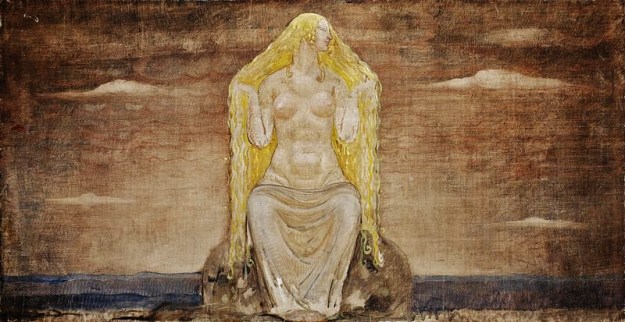
Freya 08

There’s certainly no obvious reference to it in the surviving lore, where She’s…

View original post 693 more words
Mimir and Volsi: what were those herbs? 

There are two stories in Norse myth where part of a dead body is transformed by being rubbed with herbs. One of these is the mystical, cosmological story of Mimir’s head, which Odin revived by smearing with herbs and chanting over it. The other is a conversion narrative, in which a preserved horse’s penis is part of a house cult that St. Olaf brings to an end.

So these stories could not be more unalike. But the penis grows and “becomes lively” after the woman of the house covers it in herbs and wraps it in linen. So what herbs do you use to enliven a horse’s penis and a god’s head?

Continue reading

Freyja: the Valkyrie Goddess?

The Norse goddess Freyja and the valkyries, choosers of the slain, seem to have a lot in common. Both can take bird-form, are associated with war, magic and death, and take mortal protegés and lovers. Add that to the fact that she and Odin took half of all slain warriors each, and many have concluded that Freyja was the leader of the valkyries, the valkyrie goddess if you will.

Continue reading

Skadi: the Sources

The goddess Skadi has one main myth, but it is a well-developed story, spanning three generations, and involving the feud between the gods and giants. The actual story is scattered around through a variety of sources, but its outline is clear.

Continue reading

Will the real sun-god (dess?) please stand up?

It seems almost ridiculous to be writing a post proving that Norse had a sun-goddess. After all, it’s right there in the sources that the sun is a goddess, either a human plucked from the earth to drive the sun’s chariot, or else a being who goes back to the time of creation.

Continue reading

Mercurius Rex and Odin

Mercury, the travelling god, with his hat and staff and cloak, is easily compared to Odin, the god with the wide-brimmed hat, blue cloak, and staff or spear. Both seem to be able to travel through all the worlds, both are connected to the dead, and both are tricky to deal with. Both rely on their cleverness to get them out of sticky situations.

Continue reading

Rosmerta II: fate, fertility and sovereignty

In my first post on Rosmerta, I focused on her as a goddess in her own right. This time around, I want to examine the ideas put forth in Michael Enright’s thesis Lady with a mead-cup, which argues that the cult of Rosmerta and Mercury was the basis for the later cult of Odin and various prophetic, mead-serving goddesses (and others) associated with him.

Continue reading

Fensalir and Frigg’s foresight

Fensalir, Frigga’s home, has sad associations. Its only mention in Eddic poetry is a verse in Völuspá, which tells us that she weeps at Fensalir after her son Baldr dies. Snorri Sturluson expands on this – he says that it was at Frigg’s home that Loki tricked her into revealing Baldr’s weakness.

Continue reading

Sokkvabekkr and Saga: Beneath the Waves

In my post on the enigmatic Norse god Hœnir, I mentioned two goddesses, Frigga and Saga. I argued that Hœnir personified poetic memory and inspired speech. His partner, Mimir, was the god of memory, without whom he couldn’t speak at all. Like our gods, Frigga and Saga have access to the knowledge of fate and of history. And like our two gods, one of them tells about it, the other doesn’t.

Continue reading

Hoenir, Memory, and Inspired Speech

Although Hoenir was a companion to Odin and Loki, two well-publicized Norse gods, very little has survived about him, and he does not seem to have had cult places or worshippers.

Which is surprising in a way, because in Völuspá he is the one performing the old rites after the world is reborn, so you automatically think “priestly god”. Several scholars have decided that his role was in fact a priestly or vatic one, based on this.

Continue reading