Category Archives: Greek

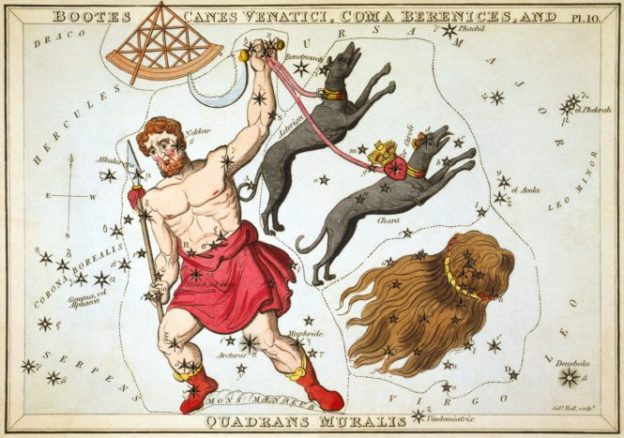
Arcturus: Bear-Guard

Arcturus is an orange giant, and the fourth brightest star in the sky. Its moment of earthly fame came during the Chicago World Fair of 1934. There had been a World Fair in Chicago in 1893, and they calculated that light leaving Arcturus then would arrive in time for the new Fair.*

Continue reading

Apollo: the swan-god

The philosopher Plato recorded the last words of his mentor, Socrates, in a dialogue called the Phaedo. According to him, Socrates tried to console his followers by contrasting the nightingale and the swan. In myth the nightingale sang for sorrow, while swans only sang once, at their death. Socrates argued that swans sang because, as Apollo’s birds, they could foresee the joys of the afterworld.

Continue reading

Honey from an Ash

When I was young, I imagined the manna that fell from heaven as being some sort of bread, possibly akin to communion wafers. It made sense to my young, Catholic, self.

Much later in life, I had to rethink the nature of manna, because of two books. One was the Poetic Edda, and the other was The Hive by Bee Wilson (a very appropriate name). Wilson’s book talks mainly about honey from the hive, but she does mention manna or meli, as the ancient Greeks called it, which falls from ash trees.

Continue reading

Apollo Soranus: the wolf, the sun, and the sacrifice

Apollo seems to have made a habit of swallowing up other gods. He took over (or was given, according to later mythology) the oracle of Delphi, which had belonged to his grandmother, Phoebe. He seems to have taken over the healing role of a very early Greek god, Paean, and also an Italian god named Soranus.

We don’t know a lot about Soranus, but he was worshipped at Mt. Soracte in Etruria, an area sacred to underworld gods like Dis Pater. Like most of the Italian gods, he had a partner, Feronia, whose sanctuary stood next to his. Although his cult may have involved the otherworld and the dead, his name is probably connected to that of the Etruscan god Suri, a god of purification and prophecy.

Continue reading

Asteria: the Night Oracles

Asteria is another Greek star-goddess, but of a rather different type. She was associated with oracles of darkness, such as prophetic dreams, astrology, falling stars, and necromancy. (Her daughter Hecate, the witch’s goddess, would follow in her footsteps.) She was sometimes blended with the night-goddess Nyx, an alternate mother for Hecate.

Continue reading

Astraea: Star Goddess of the Golden Age

During the Golden Age, Greek mythology tells us, the immortals and humans lived together on Earth. As time passed, and the Bronze and Iron Ages came, humans became less moral, and finally during the Iron Age (according to Ovid) Astraea, the only Immortal who still lived on Earth, fled to the heavens:

Continue reading

Apollo, Odin and Lugh

These Greek, Nordic and Celtic gods may not seem to have much in common at first glance, but they resemble each other in several ways, all of which illuminate aspects of their characters. All three are intellectual, associated with the arts, and have magical or oracular powers in addition to an unforgiving nature.

Continue reading

Helios: He Who Gladdens Mortals

Helios, the Greek sun-god, doesn’t get much press. Compared to the oracle-god and plague-sender Apollo, he gets hardly any. I remember once watching Jeopardy with friends and being unable to convince anyone that Helios was the sun-god, not Apollo. (I was a bit disappointed in Alex Trebeck.)

The problem that Helios faces is that he is the sun; his name means “sun” and his role in Greek myth is to rise, shine and set every day. Unlike Apollo, he is too predictable to need buying-off. In the Odyssey, when his cattle are stolen Helios has to convince Zeus to raise a storm to punish the thieves. Apollo would’ve shot ’em full of arrows.

Continue reading