These Greek, Nordic and Celtic gods may not seem to have much in common at first glance, but they resemble each other in several ways, all of which illuminate aspects of their characters. All three are intellectual, associated with the arts, and have magical or oracular powers in addition to an unforgiving nature.
Category Archives: Mythology
Helios: He Who Gladdens Mortals
Helios, the Greek sun-god, doesn’t get much press. Compared to the oracle-god and plague-sender Apollo, he gets hardly any. I remember once watching Jeopardy with friends and being unable to convince anyone that Helios was the sun-god, not Apollo. (I was a bit disappointed in Alex Trebeck.)
The problem that Helios faces is that he is the sun; his name means “sun” and his role in Greek myth is to rise, shine and set every day. Unlike Apollo, he is too predictable to need buying-off. In the Odyssey, when his cattle are stolen Helios has to convince Zeus to raise a storm to punish the thieves. Apollo would’ve shot ’em full of arrows.
Idavoll (and Idunn?)
The name Iðavöll appears twice in Völuspá, just after major cosmic events. The first, in stanza 7, follows the meeting of the Æsir where they portion out time, naming the parts of day, and the year. Stanza 6 tells us that the Æsir met at “the thrones of fate”, while 7 starts with them meeting at Iðavöll Plain, and unlike stanza 6, they physically create things, rather than just naming them.
Matrona: Mother Goddess
I have a tic; so many goddesses have been thrown into the “mother” category willy-nilly that I resist any description of a goddess as “mother”. (Also, I have noticed that people who lump goddesses together as “mothers” very often don’t consider the complexity of the title – Lotte Motz’ book The Faces of the Goddess discusses the many meanings of Mother.)
When a goddess’ name means Mother, however, you cannot deny it. It is derived from Mātr-on-ā, “Great Mother”, just like Sirona‘s and Damona‘s names mean the Great Star and the Great Cow. Inscriptions call her Dea Matrona, just to add insult to injury. There’s no way around this – she’s the Mother Goddess.
Sirius: the Scorcher
Sirius is the brightest star in the night sky – its modern name comes from the Ancient Greek Seirios (“glowing” or “scorcher”). It is actually another one of those binary stars, a white star and a white dwarf. Like Procyon, its nearness to Earth makes it much brighter in the night sky than many other stars. It is brighter than our sun, but dimmer than Rigel and Canopus.
Procyon: Torch Bearer
Procyon suffers from an inferiority complex – even its name points to a more important star. Procyon means “before the dog”, meaning Sirius, the dog-star. (Fun fact: the racoon genus is called Procyon, because it used to be thought that raccoons evolved before dogs.)
Nemetona: Sacred Groves and War-Goddesses
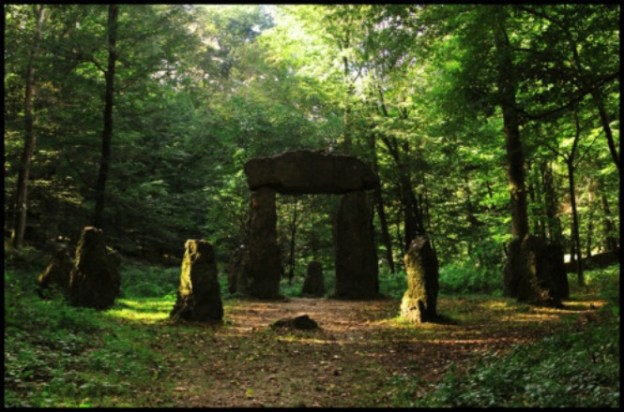
Nemetona, Goddess of the Sacred Grove, had her cult in those dense Germanic forests that the Romans feared so much. Especially after the disaster in 9 CE, when three Roman legions and their auxillaries were ambushed and cut down in the Battle of the Teutoburg Forest, they preferred open spaces to the forests in which the druids and others worshipped.
Ancamna: Guardian of the Tribe
Ancamna was a protector goddess of the Treveri, a Celtic tribe from the Moselle River area in Germany. Her cult centered on the area around Trier, known to the Romans as Treveri Augustorum (French Trèves).
Polaris: location, location, location
The North Star is not a particularly bright star; it doesn’t make the top 20. It’s no. 45, actually. What’s even more disturbing is that it hasn’t always been the pole star, and it will eventually move out of position again. The Earth’s orbit has a wobble in it, and thus the north pole rolls around a little over the course of the millennia.
Imagine the poles as the ends of the dowel sticking out of a round top, and you can imagine the north end wobbling around as the top rolls. This is a bit of a blow to myths about the north star, because they tend to stress the constancy and centrality of Polaris. Continue reading
The Cider of Immortality
In Norse myth we have two stories involving the theft of a substance that confers a magical benefit to the user. Both involve the thief taking the form of an eagle. Both involve a pursuit with a god and a giant. Of course, the two myths have very different results, although in both cases the final score is Aesir 1, Jotunar 0.
One is the myth of the giant Þiazi kidnapping Iðunn to get the apples of immortality, the other is the story of how Oðin stole the mead of poetry from the giant Suttungr.