Category Archives: Romano-Celtic

Venus, from Wikimedia

Sirona: the star goddess

Like Belisama, Solimara and Sulis, Sirona’s cult centers on healing water, whether hot springs, baths or wells. Her name, however, means something like “Great Star”, which would make her a star-goddess, rather than a solar one. She is linked to several gods, including the Roman sun-god Apollo, as well as the gods Grannus and Atesmertius.

Continue reading

honeycomb bees

Nantosuelta: Domestic Goddess

Nantosuelta was a Gaulish goddess, although traces of her worship have turned up in Germany, Luxembourg and Britain. She can be identified by the little house that she often carries, which looks like a birdhouse on the end of a long pole.

No other deity carries it, so we always know it’s her when we see it. No one really knows what it is supposed to represent – perhaps she was a goddess of home and hearth?

Continue reading

dark sun

Bricta/Brixta: Dark Side of the Sun

Bricta is a complex goddess, whose name comes either from the same root as Brigit: “Highest”, or else from a Gaulish word for a spell or curse. Her cult centers on Luxeuil in France, which is rich in thermal and other springs. Several dedications to her, as well as many offerings, were found at the site of the Gallo-Roman thermal baths.

Continue reading

Solimara: the Great Sun

Solimara was a sun-goddess, probably a tutelary goddess, from Bourges in central France. The Roman-era town of Solicia or Solimariaca, modern Soulosse-sous-Saint-Élophe, was named after her.

Continue reading

Rigantona – the Theoretical Goddess

This post is a bit of a swizz – the name Rigantona is actually a hypothesis, a reconstruction by linguists of the origins of the name Rhiannon. There are no images, inscriptions or literary references to Rigantona.

There are, however, a few inscriptions to a goddess Rigana (whose name would be cognate to Latin Regina). Sometimes these goddesses are associated with Juno or Minerva (Jufer & Lughinbuhl: 13), other times they appear on their own.

Continue reading

Rosmerta: not just a consort goddess.

Since the goddess Rosmerta often (not always) appears with the Roman god Mercury in both inscriptions and art, it is generally assumed that she is his consort, and the images that show her with his attributes indicate that he was the more powerful partner. There is a strong case to be made, however, for reading it the other way around.

Continue reading

cow wallpaper

Damona: Divine Cow of the Sacred Waters

Although the name Damona means something like “Divine/ Great Cow”, the only image we have of her is in human form, and it has only survived in fragments: a stone head, crowned with corn-ears, and a hand with a serpent’s coils around it. It turned up in a votive pit at Alise-Sainte-Reine, ancient Alesia, the centre of her cult. It was originally painted, Roman-style, with the body painted white, the hair red, with a green diadem and yellow grain.

Continue reading

Brigantia Resurfacing

I have been following the goddess Brigantia for some time now. I remember in 2009 a new inscription dedicated to Brigantia surfaced. (It had been previously mistranslated, but the new R.I.B. changed that.) It had been read as a dedication to the Terra Batavorum, but now it is read as Tutela Brigantia Augusta (Guardian Brigantia Augusta).

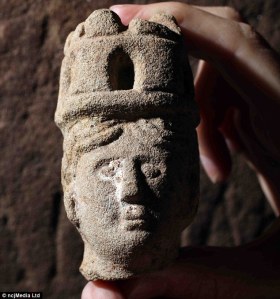
Now, however, we have a new image of the goddess, found in South Shields (near Newcastle). She still has traces of pink paint on her face, and red on her lips. So far all that has been found is her head, which is thought to date back to the second century CE (like the other dateable evidence for her cult).
1412766849251_Image_galleryImage_The_face_of_a_goddess_who

Head of Brigantia statuette. Photo from the Daily Mail.

Brigantia as guardian is apparent in both image and inscription, as the little head wears the mural crown, which indicated that a goddess was the protector of a city or territory. The famous image of Brigantia from Scotland also has a mural crown worn outside a Minerva-like helmet.

The new image of Brigantia was found at the old Roman fort of Arbeia, not too far from another altar discovered long ago. It will be exciting if they find the rest of the little image of Brigantia, but as this find and the dramatic find of Senua earlier show, the book on Roman Britain is still being written.

sea shells beach

Garmangabi: Matres and Mortality

The porch of an Anglican church might seem like a strange place to find an altar to a pagan goddess. In Lanchester, Co. Durham, however, a stone altar to the goddess Garmangabi coexisted with the established church.

Continue reading