Mardoll’s Tears and the Shining Sea

When writing my last post on Heimdall, I wondered if his name was connected to one of Freyja’s by-names, Mardoll. It’s usually translated as “Beauty of Light on Water”, perhaps inspired by the sun sparkling on the sea. It’s an appropriate name for Freyja, too, since her father controlled the waters, and she was the most desirable of goddesses.

The Scandinavians were a coastal people, who relied on the sea for food, trade and travel. Winter was when ice closed up harbour entrances and people stayed home; sun shimmering on the water meant spring had come and travel could begin again.

Continue reading

Is Isis a Moon Goddess or a Sun Goddess? (Reblog)

After all, the Egyptians seem to have associated the moon with gods: Thoth, Khonsu, Aah. The Greeks, however, saw the moon as feminine, so when the Ptolemies ruled Egypt, Isis became a moon goddess. Isis is a very complex goddess, however, who can’t be defined by any one function or aspect.

Isidora's avatarIsiopolis

A lovely painting of a lunar Isis by artist Katana Leigh. Visit her site here. A lovely painting of a lunar Isis by artist Katana Leigh. Visit her site here.

Modern Pagans often think of Isis as a Moon Goddess. And, it’s true, in later periods of Her worship, She was indeed associated with the Moon—and, in fact, that’s how She entered the Western Esoteric Tradition. The Isis-Moon connection first started when Egypt came under Greek rule in the 3rd century BCE, following the conquest by Alexander the Great. To the Greeks, Goddesses were the lunar Deities, so as Isis made Her way into Greek culture and hearts, Her new devotees naturally associated Her with the Moon.

In Egypt, Osiris, Khons, Thoth, and I’ah were the Deities most associated with the Moon. Isis, for Her part, was connected with the star Sirius as far back as the Pyramid Texts; the star was said to be Her ba, or soul. Yet Isis is also linked…

View original post 755 more words

Spring’s Victory: the Goddess Hretha

Two weeks ago I wrote about the goddess Eostre, who gave her name to the Easter festival. In Anglo-Saxon times, Eostre’s festival was in April, while March belonged to another goddess, Hretha.

If we know very little about Eostre, we know even less about Hretha. The only source we have for either of them is the Venerable Bede‘s book on the calendar, where he lists the names of the Anglo-Saxon months in England, with brief explanations of each name. I think you’ll agree his descriptions are terse:

Continue reading

The Horned God: Not as Old as You Think (Reblog)

Reblogged from Jason Mankey’s Raise the Horns blog on Patheos:

The Horned God: Not As Old As You Think

What’s in a Name? Defining Eostre as a Goddess

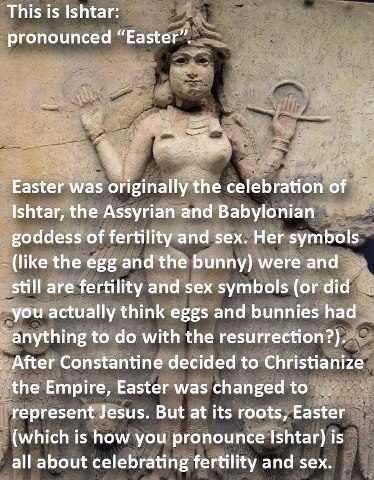
Last week I reblogged an article about how Eostre, the Easter goddess, was not the same as the Middle Eastern goddess Ishtar. No doubt some of you were wondering who exactly Eostre was, and how she was connected to Easter (apart from their names sounding similar).

Continue reading

Why Ishtar is Not the Easter Goddess (Reblog)

via Easter, Ishtar and Eostre

ishtar

Athena as Metis’ daughter

Athena is famous for many things, but her birth, springing fully formed from her father’s head, is a well-known part of her myth, depicted on blackfigure vases from early Greece and mentioned by Homer and Hesiod. Her mother, Metis, is less well-known, although it was she who actually gave birth to Athena, inside Zeus’ belly.

Continue reading

Zisa: the Augsburg Goddess or Invented Tradition?

You’ll sometimes see Cisa or Zisa listed among the Germanic goddesses, usually with some statement to the effect that she is the partner of Tiw/Ziu, a god the Romans saw as similar to Mars. Nigel Pennick mentions her in his works, calling her an earth-goddess, and Jacob Grimm devoted several pages to her in his Teutonic Mythology.

Urglaawe, a branch of Heathenry that incorporates Pennsylvania Dutch folklore, considers Zisa one of their deities, with the 28th of September as her day, and the pinecone as her symbol. They draw their inspiration from the legend of a goddess Zisa or Cisa who gave her name to the city of Augsburg and protected it from an attack by the Romans.

Continue reading

When Did Hecate Become a Crone Goddess? (Reblog)

via Is She the Crone? Hekate’s Profanation?

Senuna

Most of us have heard the romantic story of how a new Celtic goddess, Senuna, was discovered after nearly 2000 years by amateurs with metal detectors. Twenty-six pieces of gold and silver had been deposited in a pool at Ashwell, UK, presumably from a nearby shrine, where they had been been offered to the goddess.

Continue reading